 Add to Chrome
 Add to Firefox
 Add to Edge
Automated Random Embedding for Practical Bayesian Optimization with Unknown Effective Dimension
May 25, 2026
Bayesian optimization is widely employed for optimizing complex black-box functions but struggles with the curse of dimensionality. Random embedding, as a dimension reduction strategy, simplifies tasks that possess the effective dimension by optimizing within a low-dimensional subspace. However, determining the effective dimension of a task in advance remains a significant challenge, which influences the selection of the subspace dimensionality and the optimization performance. Traditional methods use fixed subspace dimensions provided by experts or rely on trial and error to estimate subspace dimensions with resources consumed. To this end, this paper proposes an automated random embedding for high-dimensional Bayesian optimization with unknown effective dimension, called Dynamic Shared Embedding Bayesian Optimization (DSEBO). DSEBO starts with a low dimension and switches to a higher subspace if the solutions in the current subspace show preliminary convergence. DSEBO dynamically determines the dimension of the next subspace based on the quality of the solutions in different subspaces and shares the queried solutions with the new subspace for a better initialization. Theoretically, we derive a regret bound for DSEBO and demonstrate that DSEBO can better balance approximation and optimization errors. Extensive experiments on functions with dimensionality of varying magnitudes and real-world tasks with unknown effective dimensions reveal that, compared with state-of-the-art methods, alternating optimization across different subspaces results in significant improvements in high-dimensional optimization, both in terms of optimization regret and time.

Surg-R1: A Hierarchical Reasoning Foundation Model for Scalable and Interpretable Surgical Decision Support with Multi-Center Clinical Validation
Mar 12, 2026Surgical scene understanding demands not only accurate predictions but also interpretable reasoning that surgeons can verify against clinical expertise. However, existing surgical vision-language models generate predictions without reasoning chains, and general-purpose reasoning models fail on compositional surgical tasks without domain-specific knowledge. We present Surg-R1, a surgical Vision-Language Model that addresses this gap through hierarchical reasoning trained via a four-stage pipeline. Our approach introduces three key contributions: (1) a three-level reasoning hierarchy decomposing surgical interpretation into perceptual grounding, relational understanding, and contextual reasoning; (2) the largest surgical chain-of-thought dataset with 320,000 reasoning pairs; and (3) a four-stage training pipeline progressing from supervised fine-tuning to group relative policy optimization and iterative self-improvement. Evaluation on SurgBench, comprising six public benchmarks and six multi-center external validation datasets from five institutions, demonstrates that Surg-R1 achieves the highest Arena Score (64.9%) on public benchmarks versus Gemini 3.0 Pro (46.1%) and GPT-5.1 (37.9%), outperforming both proprietary reasoning models and specialized surgical VLMs on the majority of tasks spanning instrument localization, triplet recognition, phase recognition, action recognition, and critical view of safety assessment, with a 15.2 percentage point improvement over the strongest surgical baseline on external validation.
USTC-KXDIGIT System Description for ASVspoof5 Challenge
Sep 03, 2024
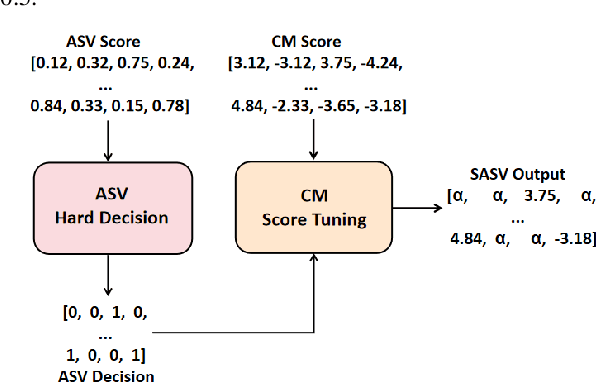
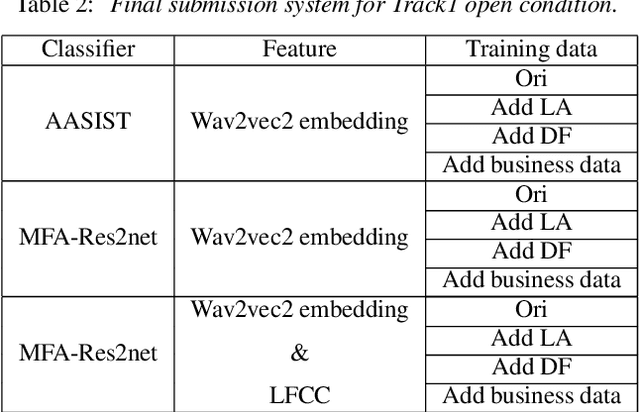
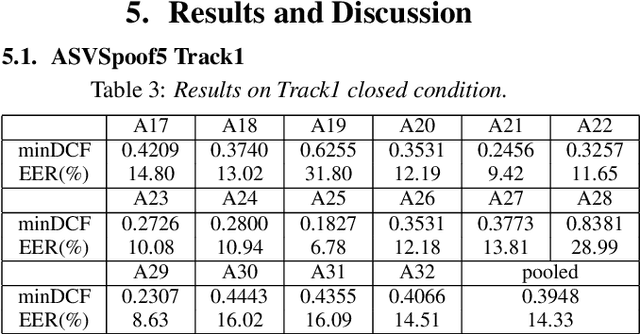
This paper describes the USTC-KXDIGIT system submitted to the ASVspoof5 Challenge for Track 1 (speech deepfake detection) and Track 2 (spoofing-robust automatic speaker verification, SASV). Track 1 showcases a diverse range of technical qualities from potential processing algorithms and includes both open and closed conditions. For these conditions, our system consists of a cascade of a frontend feature extractor and a back-end classifier. We focus on extensive embedding engineering and enhancing the generalization of the back-end classifier model. Specifically, the embedding engineering is based on hand-crafted features and speech representations from a self-supervised model, used for closed and open conditions, respectively. To detect spoof attacks under various adversarial conditions, we trained multiple systems on an augmented training set. Additionally, we used voice conversion technology to synthesize fake audio from genuine audio in the training set to enrich the synthesis algorithms. To leverage the complementary information learned by different model architectures, we employed activation ensemble and fused scores from different systems to obtain the final decision score for spoof detection. During the evaluation phase, the proposed methods achieved 0.3948 minDCF and 14.33% EER in the close condition, and 0.0750 minDCF and 2.59% EER in the open condition, demonstrating the robustness of our submitted systems under adversarial conditions. In Track 2, we continued using the CM system from Track 1 and fused it with a CNN-based ASV system. This approach achieved 0.2814 min-aDCF in the closed condition and 0.0756 min-aDCF in the open condition, showcasing superior performance in the SASV system.